
Our crises are shared: Doug Ford’s government to defund safe consumption sites, drive toxic drug crisis death toll
Supervised consumption sites save lives
From P.O.W.E.R., Surrey Union of Drug Users & Care Not Cops
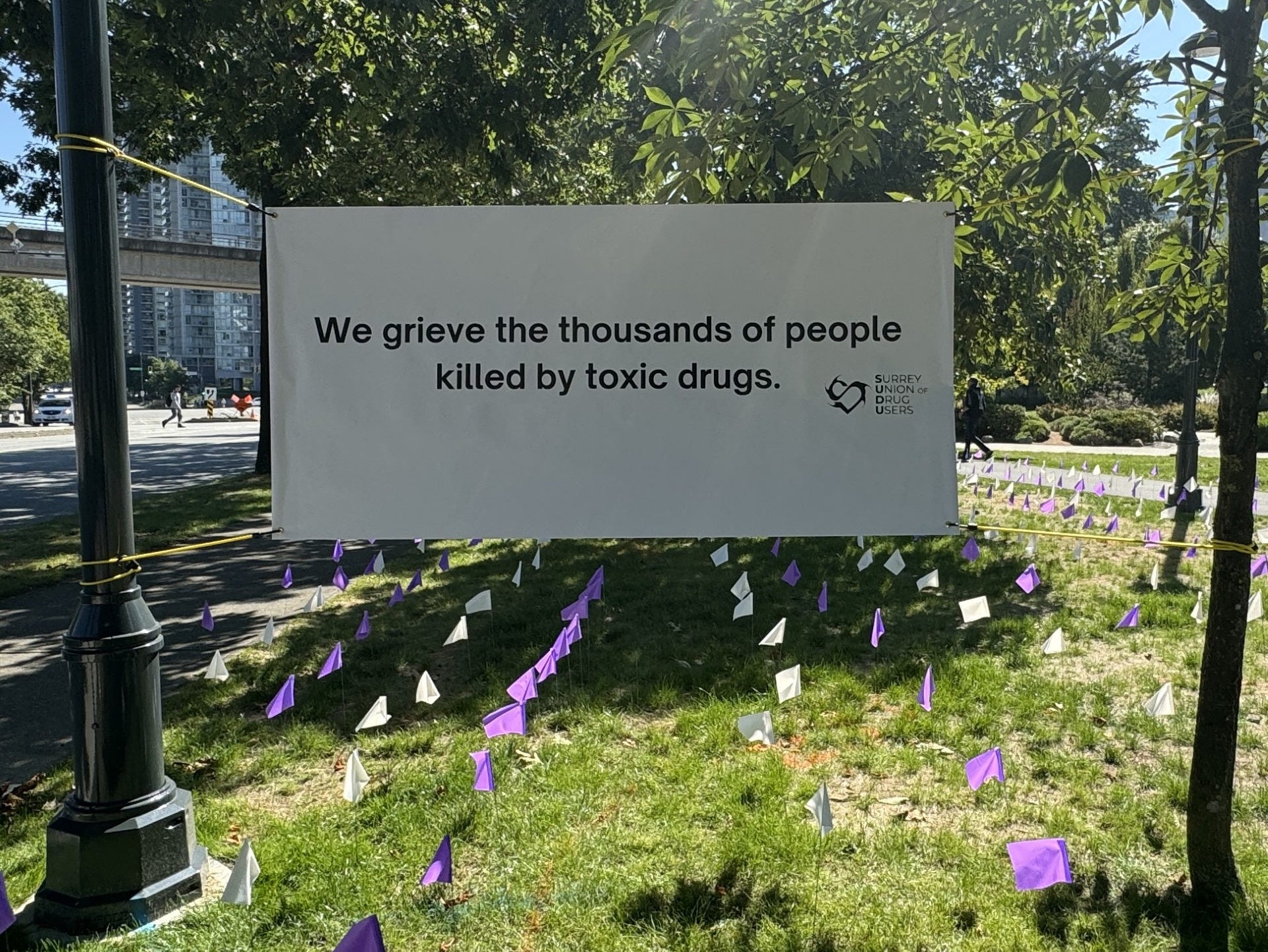
It has been revealed that the Ontario government plans to defund and shutter remaining provincially-funded safe consumption sites (SCS) by June — during an ongoing toxic drug crisis.
This follows Ontario’s passing of Bill 223 in 2024, which restricted where a SCS can legally operate in the province.
In a press conference, a number of Ontario-based community leaders – including from the HIV Legal Network, Toronto Indigenous Harm Reduction, and Toronto Overdose Prevention Society – condemned the closures.
Dayn Kent, the former manager of Regent Park consumption site in Toronto, which was shut down under Bill 223, shared that Regent Park saw roughly 850 unique individuals per year, supervised 6,000 injections and completed 6,500 service referrals in 2023 and 2024.
Kent was one of many speakers who illustrated how SCS can reduce the strain on the healthcare system.
Dr. Sarah Griffiths, an Ontario-based emergency physician, described how the ever shifting drug supply complicates overdose response, “These overdoses take hours to respond to…and without safe places to be monitored, [people] will be in our incredibly busy emergency departments.”
A former service user of Toronto’s Moss Park SCS, Akosua Gyan-Mante, shared her experience with SCS, “You can’t understand the feeling of being so alone and coming to a place where people love you for you. When everybody else passes you by and doesn’t give you another look, all of these people come to this place for safety and love.”
Gyan-Mante contrasted this with Ford’s approach, “We are sticking people all together, and just leaving them there to die…just leaving them in very poor conditions to die.”
These same political logics are playing out across Canada – while drug war panic is being pushed by policing organizations and other benefactors of the status quo.
Today, P.O.W.E.R., the Surrey Union of Drug Users and Care Not Cops endorse and amplify the condemnation of SCS closures made by our colleagues in Ontario.
Pete Woodrow, a long-time community leader and board member of SUDU says, “The struggles that we’ve had, the moves that we made, it’s like every day we wake up and something new is being taken away from us. We fought for the smallest smidgen of progress, and now it’s being taken away in Ontario, without even consulting anyone.”
“This is creating hopelessness. We saw this 10 years ago. We already know what’s going to happen, I lost a lot of people 10 years ago. OPS [overdose prevention sites] brings community, it gives us a space to come together and be together and they’re taking that away.”
In January, Vancouver lost its only overdose prevention site in the city-centre area (outside of a hospital). City centre is one of the regions in BC that saw the most people die by overdose in 2025. BC’s response to the toxic drug emergency has been described as inadequate by the province’s Auditor General, while the Office of the Human Rights Commissioner has taken the position that the ongoing crisis is a human rights violation.
“You can’t understand the feeling of being so alone and coming to a place where people love you for you. When everybody else passes you by and doesn’t give you another look, all of these people come to this place for safety and love.”
Surrey – three times the geographical size as Vancouver – still has just one supervised consumption site.
The public health evidence for SCS is unequivocal – three decades of evaluations show that the intervention saves lives, particularly the lives of people who make up the margins of traditional public health modeling, while also contributing to the reduction of other neighbourhood-level social issues, such as reductions in crime.
“They just want us to crawl into the fucking sewers. Out of sight out of mind bullshit,” says Nathan, a board member with SUDU.
Elder Mona Woodward, the president of SUDU, calls the planned SCS closures “a death sentence.”
The Ford government, of course, knows all this – and non-SCS social services have already reported increases in overdoses at their sites in Ontario since the passing of Bill 223. This can only imply that Ford’s government has made the decision to interfere with people’s right to life and security of the person – just as community leaders in Ontario expressed during their presser.
Harley Ransom, a board member of Western Aboriginal Harm Reduction Society and P.O.W.E.R. member grew up in Ontario and worries about his home community, “My buddy in rural Ontario — they drive around to all the small towns and hand out harm reduction which is well needed also got their funding cut. Now I grew up here so no one understands more than me how much this is needed to help fight the spread of HIV and Hepatitis C.”
“This is creating hopelessness. We saw this 10 years ago. We already know what’s going to happen, I lost a lot of people 10 years ago. OPS brings community, it gives us a space to come together and be together and they’re taking that away.”
“The state cannot police its way out of a toxic drug supply crisis. Supervised consumption sites keep people alive. For decades, people who use drugs and co-collaborators have fought to build spaces where those deemed disposable can survive and exist with the dignity they deserve,” says Heather Tunold, a community harm reduction educator and member of Care Not Cops.
She adds, “Shutting down supervised consumption sites during an ongoing toxic drug crisis is a deliberate dismantling of care — and a clear signal that our kin are considered unworthy of life, care, and liberty.”
While both Ontario and BC’s governments continue to do nothing to undercut the toxic supply – or worse, such as crackdown on criminalized drug markets through raids and seizures, which makes the drug supply even less predictable – they are now forcing life-saving interventions to shutter their doors.
From BC, we see ourselves among our friends and kin in Ontario impacted by the toxic drug crisis, and in collective resistance to a state sanctioned massacre against the public. We grieve thousands, and we resist in their spirit.
BACKGROUND
Safe Consumption is a Labour Issue: Workers Call for the Reversal of Deadly SCS Closures: CUPE Ontario & other labour organizations
Colonial Policing in a Drug Crisis: How Bill 6 and Bill 223 Endanger Lives: Amnesty & Toronto Indigenous Harm Reduction Network
Safety for Whom? Ontario’s War on Safe Consumption Sites is No Act of Care: Yellowhead Institute
‘It’s our safe sanctuary’: Experiences of using an unsanctioned overdose prevention site in Toronto: International Journal of Drug Policy
Harm reduction activists have our trust; without their activism, we would all be left to die: Drug Data Decoded
Impacts of the COVID-19 pandemic on supervised consumption service delivery in Vancouver and Surrey: Discover Public Health
Supervised safe consumption sites — lessons and opportunities for North America: The Lancet Regional Health
Paramedic calls for suspected drug overdoses nearly double in Sudbury: CBC News
Not So Simple: The impact of simple drug possession and trafficking offences on health equity: HIV Legal Network
Brief report on pop-up OPS: Surrey Union of Drug Users